Step into the joyful world of Beryl Cook
Ahead of a new centenary exhibition, David Trigg finds out why Beryl Cook's always publicly popular works are now being critically reappraised.
A version of this article first appeared in the winter 2025 issue of Art Quarterly, the membership magazine of Art Fund.
Celebrated for her pictures of larger-than-life women out on the town, drinking in pubs, eating in cafés or just having a laugh, Beryl Cook (1926-2008) painted what she knew and loved. A keen observer of everyday social situations, she captured joyful, sometimes raucous, moments in the lives of ordinary people. Shooting to fame in the mid-1970s, the self-taught painter became one of Britain’s most visible artists as her works were disseminated via cards, calendars, tea towels and prints.
Despite being loved by the public, who appreciated her relatable subjects and earthy humour, the artworld largely dismissed her work as low brow, equating it with saucy seaside postcards. In January, the Box in Plymouth is marking the centenary of Cook’s birth with the most extensive presentation of her work to date. Featuring works that have rarely or never been exhibited, the show draws on new research and archival discoveries to reassess her important contribution to British art.
Cook was in her late thirties when she began dabbling with painting, discovering a newfound love for image-making after picking up her son’s paint set. Living in the Cornish seaside town of Looe, she painted on anything she could lay her hands on: old boards, cardboard, even driftwood. In 1968, Cook and her family moved to Plymouth, where she lived and worked for the rest of her life; she ran a bed and breakfast filled with her colourful paintings.
When Bernard Samuels, director of Plymouth Arts Centre, saw her work, he persuaded her to have her first public exhibition in 1975. It was an instant success, leading to a major feature in The Sunday Times Magazine, a television appearance on The South Bank Show and representation with London’s Portal Gallery. Although awarded an OBE in 1996, Cook still divided opinion, and her work sparked regular debates about the distinction between so-called high and low art.
‘This exhibition is a chance for us to present a wider contextualisation of Cook’s practice, highlighting how she documented everyday life during a time of massive social change,’ explains the Box’s art curator Terah Walkup. Among the paintings displayed for the first time is Bingo (1984), acquired for the Box’s collection with Art Fund support. It shows an exuberant woman waving her winning bingo card triumphantly in the air as her fellow players look on, unimpressed. Remarkably, Walkup has identified the Plymouth bingo hall depicted here, spotting the scene on a local television news clip in the Box’s archive.
‘It was a report about the sociability of older women in the 1980s, how they found spaces to meet each other and enjoy a sense of independence,’ she explains. As with many of Cook’s paintings, Bingo speaks to the broader sociopolitical context in which it was made. More than just a humorous scene, it is a record of its time.
Another piece making its debut is Reading Sunday Papers (1973), an early work that depicts beachgoers in colourful, patterned swimwear, one of whom is literally caught with their trousers down. ‘Cook was great at capturing people at awkward moments,’ says Walkup. But what also catches the eye is that the seated characters are reading tabloids constructed from actual newsprint – collages of saucy and sensational headlines.
‘It speaks to her representation of the media,’ Walkup opines. ‘The central figure’s eyes look tired, and that seems so relevant to today’s doomscrolling and constant can’t-look-away overconsumption of media.’ Also on display is a rare self-portrait from the mid-1960s, also acquired with Art Fund support. ‘This image shows Cook in her fluffy slippers taking a nap on a sofa,’ Walkup explains. ‘And she has captured herself in a rather vulnerable moment with her mouth wide open, maybe during a snore, so we see her humour already, even in images of herself.’
‘There will be no Beryl Cooks in Tate Modern,’ declared former Tate director Nicholas Serota in 1996, and to this day Tate does not own any of her works. Yet despite her detractors, Cook had many artworld admirers, not least critic Edward Lucie-Smith with whom she had a close friendship and extensive correspondence. ‘Having access to these letters in Cook’s archive has provided an incredible new lens through which to appreciate her works,’ says Walkup, who explains that, far from being a naïve outsider, Cook was well versed in art history.
Another regular correspondent was the photographer Barbara Ker-Seymer (1905-93), who greatly admired Cook’s paintings and was instrumental in connecting her with Edward Burra (1905-76). Indeed, artists such as Burra and Stanley Spencer (1891-1959) made a huge impression on her, and it’s not hard to detect their influence. ‘Cook was very vocal in her letters about admiring Spencer’s work, and there is a lot of discussion about Burra, who was also fascinated with nightlife and the urban underworld,’ says Walkup. Paintings by both artists feature in the exhibition, along with pieces by others with whom Cook felt an affinity, such as Peter Paul Rubens (1577-1640), who celebrated plump and curvy bodies, and Pieter Bruegel the Younger (1564-1638) who, like Cook, was a sharp-eyed observer of people.
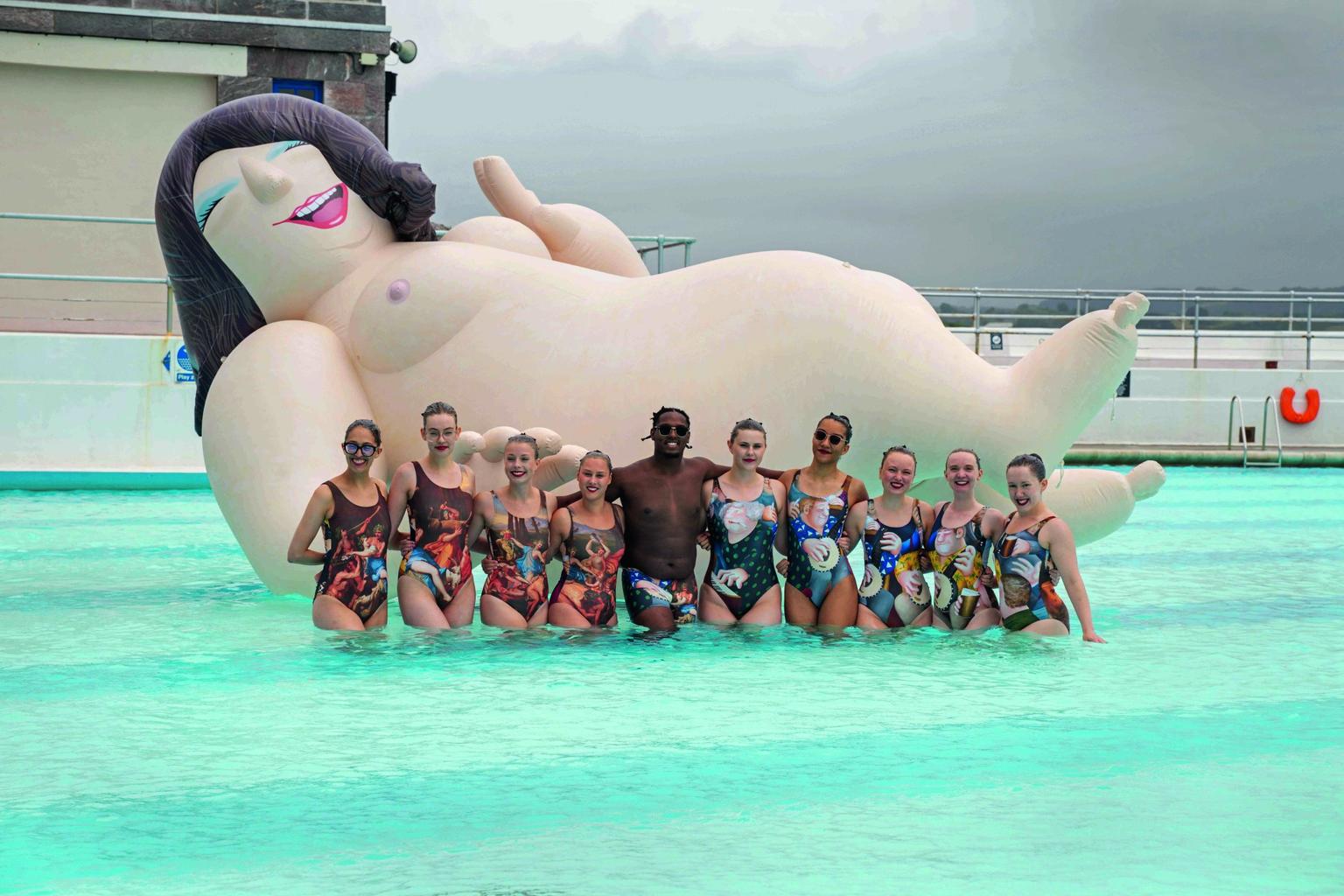
Cook’s wry and joyous social observations have also inspired contemporary artists. Jeremy Deller’s event Hello Sailor (2025) – part of The Triumph of Art, a nationwide commission supported by Art Fund that marked the National Gallery’s bicentenary celebrations – involved a five-metre-long inflatable based on Cook’s painting Nude on a Leopard Skin (1980) being paraded through Plymouth city centre. Synchronised swimmers wearing Cook-inspired costumes also performed around the voluptuous nude as she floated in Plymouth’s Art Deco lido. ‘I’m interested in pushing the envelope of what is acceptable to be called art, who makes it, and what are its limits,’ Deller said at the time, alluding to Cook’s marginalised status within the artworld
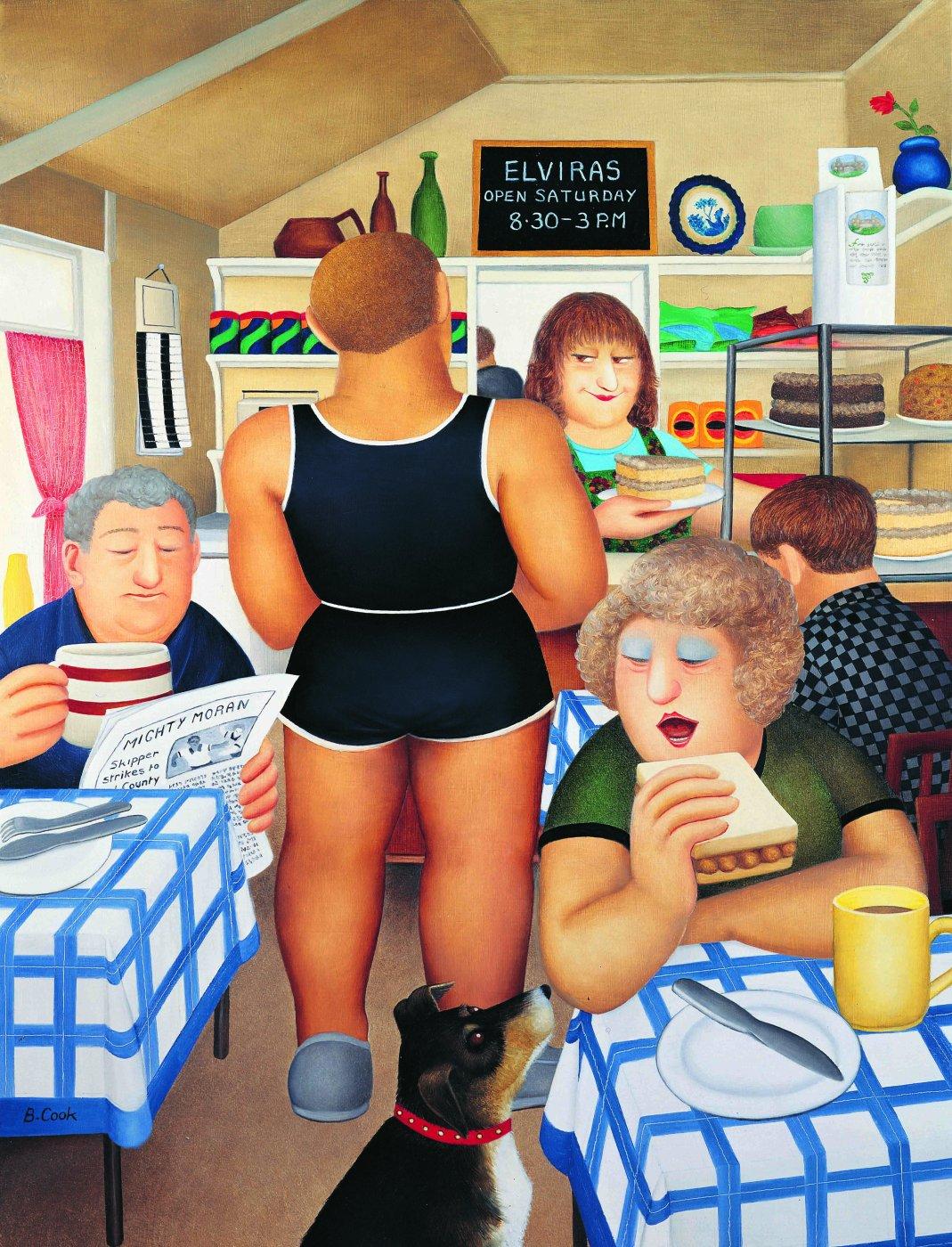
The Box’s exhibition also shares fresh perspectives from those who knew Cook, were painted by her or witnessed some of her most iconic works being created. One person who ticks all three boxes is the artist’s daughter-in-law, Teresa Cook, who was immortalised in the painting Elvira’s Cafe (1997), where she appears behind the counter of the eponymous Plymouth establishment, which she ran with her husband, John. With a cheeky smile and side-eyed glance, she serves cake to a beefy marine as customers sip tea and chomp on sausage sandwiches.
‘They were ever such nice lads,’ recalls Teresa, who explains how the marines would often pop into the café en route to the nearby Stonehouse Barracks. ‘The threat of IRA bombs meant that they weren’t allowed to wear their uniforms away from the barracks, so they used to run to work in their vests and tiny shorts,’ she says. ‘And some of them were very good looking!’ A print of the painting hung in Elvira’s for several years, and many marines laid claim to being the muscle-bound figure – a testimony to the way that people often recognised themselves in Cook’s colourful characters.
‘Often Cook was painting people who were othered or marginalised,’ Walkup says, and a significant research strand has focused on Cook’s representations of LGBTQ+ experiences, such as her paintings depicting Plymouth’s Lockyer Tavern. From the mid-20th century, the pub offered a safe space for gay men at a time when homosexuality was still illegal in Britain.
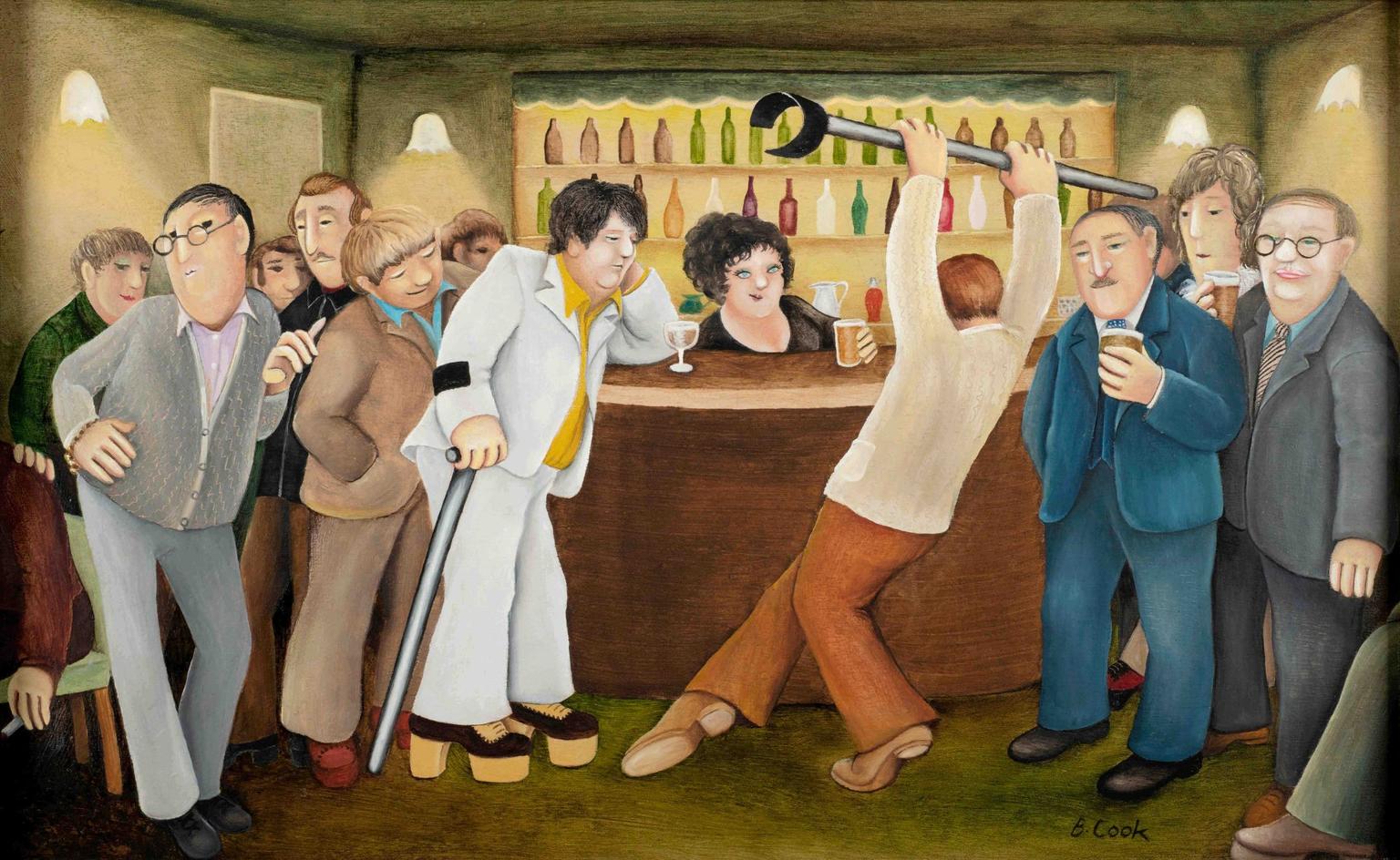
In Back Bar of the Lockyer Tavern (1976) a group of men are waiting for the drag acts to begin. One, known as Tommy, has borrowed a friend’s crutch to show off his jaunty dance moves. Cook was introduced to the pub by her great friend Tony Martin, an antiques dealer who was instrumental in securing her first sales.‘I can’t emphasise enough how important these paintings have been and still are to the queer communities here in Plymouth,’ says Walkup. ‘There are letters within Cook’s archive thanking her for painting Plymouth’s gay bars through a lens of joy and happiness.’
In 2024, non-profit London contemporary art gallery Studio Voltaire paired Cook’s paintings with the homoerotic drawings of Tom of Finland (pseudonym of Touko Laaksonen, 1920-1991), challenging the prevailing view of her work as quaint and kitsch. In presenting Cook’s gay bars, sex workers and crossdressers alongside the Finnish artist’s hyper-masculine, leatherclad bikers and cowboys, the exhibition positioned Cook as a challenger of societal orthodoxies. Walkup, however, is cautious to attribute radical intentions.
‘She was not an overtly political person; in fact, she didn’t even want to talk about politics,’ she explains. ‘What she said, repeatedly, is: “I’m just painting people enjoying themselves.” But it was the care and compassion she showed that, for me, is what’s really radical about her work. She didn’t bring any judgements around gender or bodies, and there’s no malice, misogyny or moralising in her depictions of marginalised people.’ It’s a view Teresa shares: ‘She wasn’t prejudiced about anything. It interested her that people were different from her, whether they drank in gay bars or played in the Salvation Army band.’
Surprisingly, Cook’s own disposition couldn’t have been more different from her flamboyant characters. ‘She didn’t live the high life, and she hated parties because of her shyness,’ says Teresa. ‘She never wanted to be a personality. All she really wanted to do was paint.’ Cook was even loath to be seen sketching in public and so photography took the place of traditional sketchbooks.
‘There are albums filled with pictures taken discreetly in pubs, parks and social gatherings in which you can find the reference images for many of her paintings,’ explains Walkup. One, labelled ‘Bodies’, is a beautiful collection of candid images of people out and about. ‘Here we really start to see the world through Cook’s eyes,’ enthuses Walkup, who likens these shot-from-the-hip pictures to the work of street photographers such as Vivian Maier (1926-2009) and Tony Ray-Jones (1941-72).
Visitors to the Box will also be able to discover Cook’s experiments with textiles. ‘This was never something she talked about, but she created a lot of knitting and needlepoint tapestry works,’ says Walkup. ‘There’s a really beautiful graphic, colourblocked element to a lot of her designs. She also had a small sculptural practice, so we’re really looking forward to showing people these different sides of her work.’
Although Cook used different media throughout her career, painting remained her primary love. After this, it was the fans that mattered most and she spent much of her time replying to the hundreds of letters she received from all over the world. ‘She loved her fans; they gave her a great deal of confidence,’ Teresa says. ‘She was pleased that ordinary people loved her paintings.’
In introducing Cook’s work to a new generation, Walkup hopes the exhibition will create a new raft of fans, while giving those who previously discounted her work pause to reconsider. ‘One of the joys of working on this exhibition has been all of the new research and finds,’ she enthuses. ‘There’s so much to discover in Cook’s work and my hope is that people will see it in a new light.’
Beryl Cook: Pride and Joy at The Box, Plymouth is open until 31 May 2026. The exhibition is free to all. National Art Pass holders get 10% off in café on Sundays.