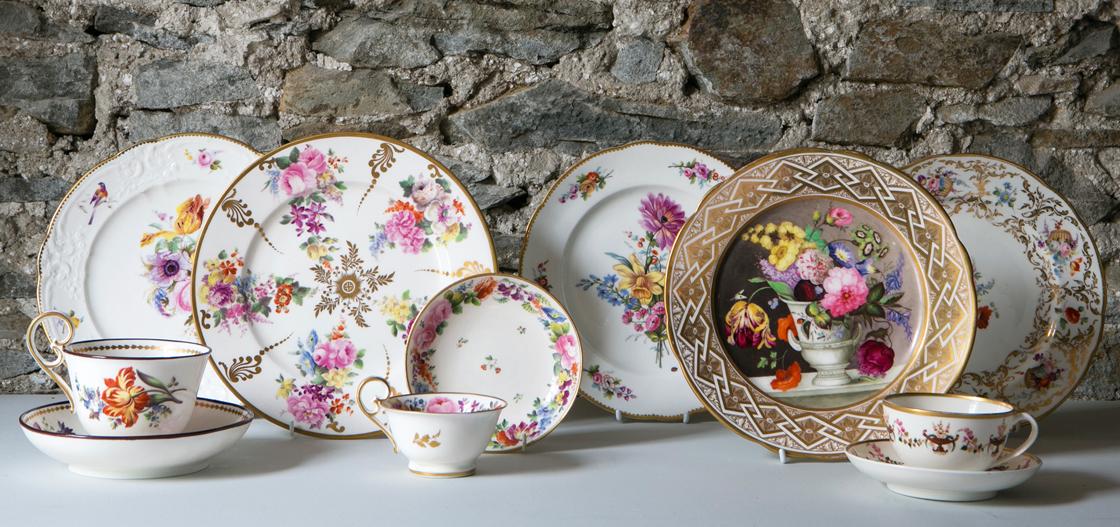
Recreating Nantgarw porcelain
In the early 19th century, William Billingsley arrived at the small hamlet of Nantgarw in South Wales and created arguably the finest porcelain ever made. However, due to the fragility of the fine body, up to 90% of the porcelain was destroyed in the kilns and despite the exceptional quality, the factory closed after only four years of operation. Today individual pieces of Nantgarw porcelain are rare, highly collectible and can swap hands for many thousands of pounds.
For two hundred years, the exact recipe and production methods have remained secret, however recent spectroscopic analysis and historic research, including coded documents unearthed in museum archives, have given us the opportunity to now recreate this extraordinary porcelain.
We need your help to raise £15,000 to recreate Nantgarw porcelain. We will use traditional and modern materials, practices and kilns to make the porcelain on the same premises used by William Billingsley in 1813. In return for your donation, you will receive a limited-edition reward to say thank you (or diolch yn fawr as we say in Wales).
Latest updates (10)
December 2017
Thanks to your support we’ve done it!
For the first time in 200 years, William Billingsley's incredible porcelain is once again, being made at Nantgarw China Works. It hasn't been easy and we are still in the very early stages, but we have succeeded in recreating the porcelain body, slip casting cabinet cups from it and firing them with very little slumping or deformation. The porcelain is intensely white, fine grained and just as incredibly translucent as the original.
Analysis of the porcelain has shown it to be virtually identical to the original, minor differences being easily accounted for by different sources and purity for some ingredients (notably kaolin).
As a result, we are well on our way to finishing all the cabinet cups for the rewards but progress is painfully slow, largely due to the porcelain's lack of plasticity requiring extreme care when removing the ornate handles from the moulds. As no one in the world has any prior experience of working with a porcelain like this, we are learning as we go and have already developed some new innovative techniques which, to our knowledge, have never been used before.
The recent sub-zero temperatures have also made the slip increasingly difficult to work with.
We hope all the cabinet cups will be finished in time for Christmas but it is possible that some may have to wait until the New Year.
William Billingsley's greatest strengths was his desire to achieve perfection so we are doing our utmost to ensure the quality of these cabinet cups would meet with his approval.
If you are desperate for your cup, perhaps because it is planned as a Christmas present, please get in touch by emailing projects@nantgarwchinaworksmuseum.co.uk and we will try to prioritise your request.
Although the Nantgarw China Works museum is now closed until the New Year, we will be showing a small exhibition about the project running from January 3rd until the end of the month. We hope you will be able to visit.
Thank you again for helping us achieve this historic accomplishment!
November 2017
Nantgarw porcelain tests are underway and rewards update
Great news!
Thanks to your support we are making excellent progress on understanding and recreating the incredible porcelain made at Nantgarw China Works during the early part of the 19th century.
We have now developed and tested our first frit which has been finely ground before being combined with china clay and other ingredients, then processed into a porcelain slip. After conditioning samples of this slip have been used to cast some simple test forms; these have been fired in our new test kiln. Other samples have been press moulded and fired.
The results so far have been extremely positive with the resultant biscuit being extremely white, fine-grained and very translucent. Some deformation of the form has been noticed under firing. Glazes have been applied and glost fired.While we still have extensive tests to complete and appreciate there are more challenges to come, initial signs are very encouraging and we believe this new porcelain exhibits all of the characteristics of that made by William Billingsley two hundred years ago.
Our newly commissioned moulds will be arriving shortly at which time we will commence casting, firing, glazing and decorating the cabinet cups offered as a reward for donors. For the first time in 200 years, a new Nantgarw China Works impressed stamp has been designed. This can be seen in the small 30mm test sample below which has been backlit to help show the porcelain’s translucency.
All the activity undertaken, with the exception of the final grinding of frit (outsourced to a specialist industrial partner), has been conducted onsite at Nantgarw China Works by the project team working in partnership with a number of specialists.
Meanwhile, our ‘shard’ pendants rewards are back from the assay office and look stunning. Each one has been handcrafted by Abergavenny jeweller Kimmi Davies and display signs of the production and firing problems William Billingsley faced at Nantgarw.
Sunday10 December will be an extraordinarily exciting day for the team as in addition to all your lovely rewards being delivered by then, we would like to extend an invitation for you to visit us for an ‘open day’. During the day we will share details of what we have accomplished on this project, provide tours of the China Works and give some demonstrations of slip casting and basic decoration. In the early afternoon there will be music and dancing from the famous band “Nantgarw” and of course mince pies and mulled wine.
Thank you again for your support.